
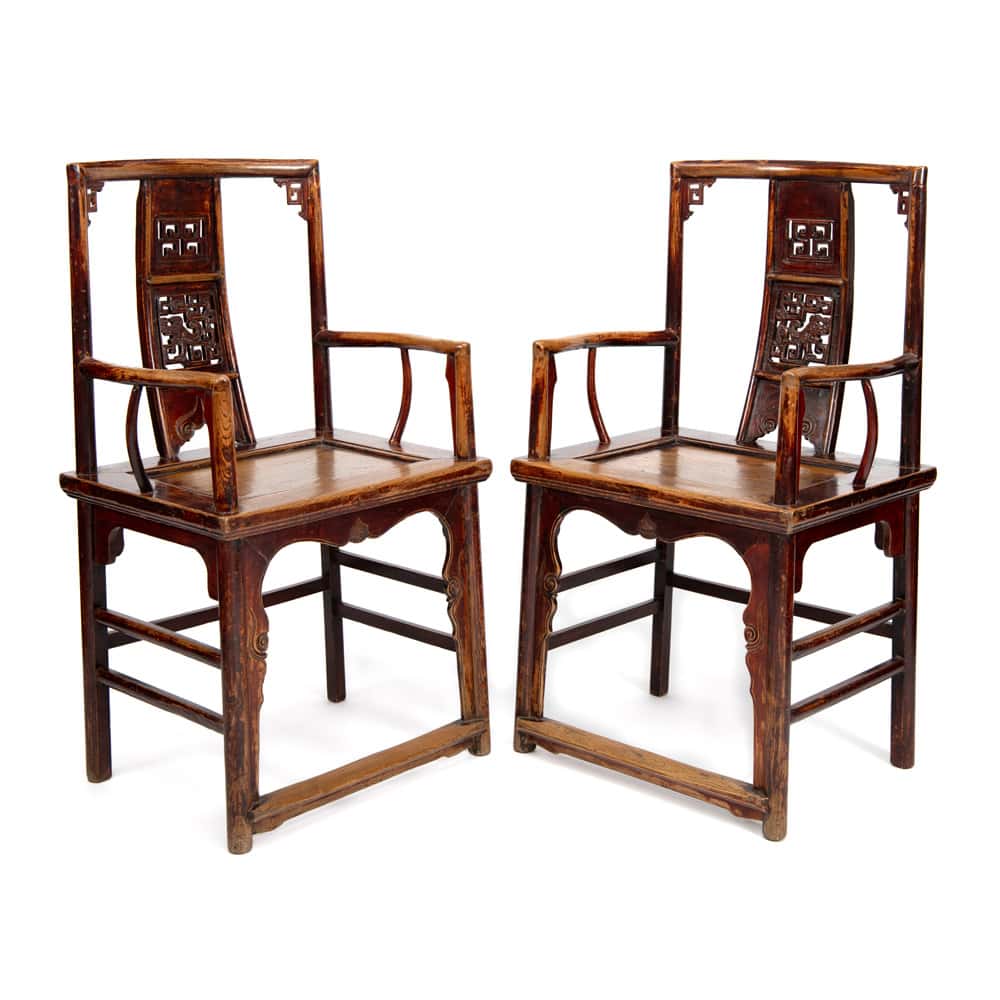
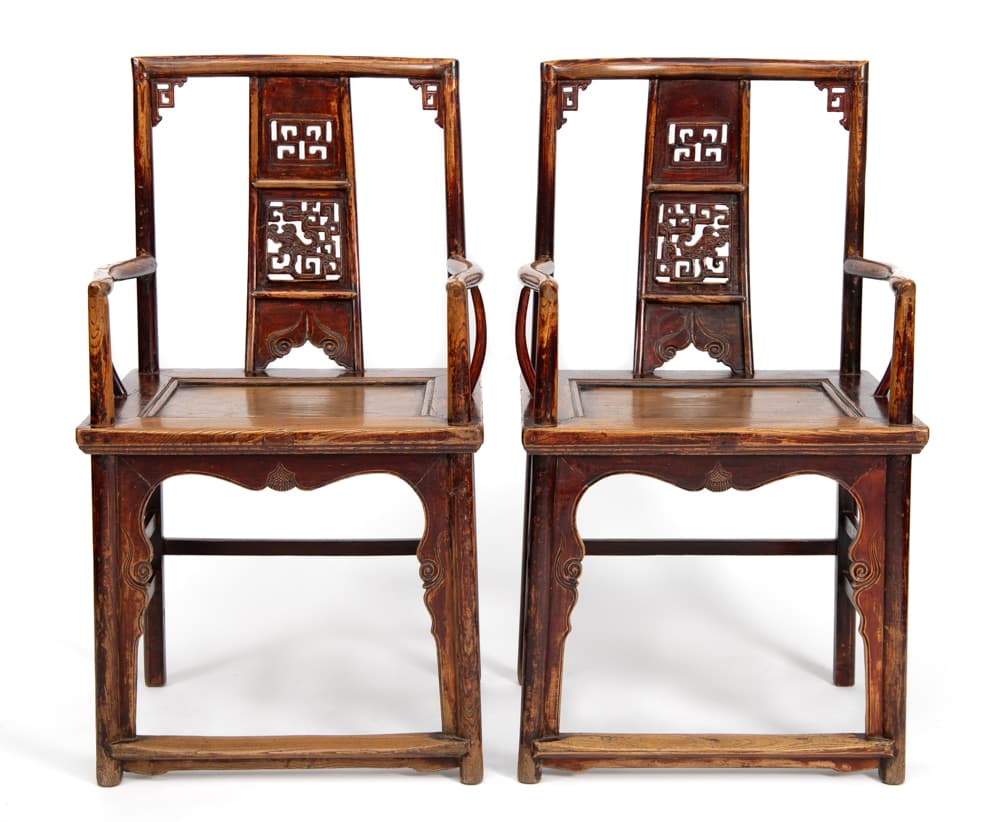
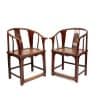
Southern Official hat armchairs with dragon carving
$6,400.00
Price is for pair of chairs
19th century
- elm wood
- 57cm wide x 45cm deep x 143cm high
Antique 19th Century Southern Official’s Hat Armchairs with Open Dragon Carving
This commanding pair of 19th-century Chinese Southern Official’s Hat armchairs (Nanguanmaoyi) exemplifies classical proportions combined with intricate Qing-period openwork. Crafted from solid Northern elm wood (yumu), each chair features a continuous curved crest rail seamlessly joined to the rear stiles via traditional mortise-and-tenon joints, gracefully undulating arms supported by slender curved side posts, an inset hard-mat wooden panel seat, and a shaped apron framing an integrated footrest. The standout feature is the three-tiered central backsplat, highlighted by a pierced openwork dragon medallion and stylized fretwork.
Evolution & Design
From “Four Protrusions” to Continuous Curves: Official’s hat chairs (guanmaoyi) take their name from the winged hats worn by Song and Ming dynasty civil officials. While Northern-style chairs (sichutou) feature protruding crest rail ends and armrests, the Southern Official’s Hat design (nanguanmaoyi) evolved as a sleeker, continuous variant where the top yoke rounds smoothly into the corner posts.
Qing Dynasty Carving Tradition: Originating in the minimalist aesthetic of the Ming scholar class, the form evolved during the Qing dynasty to incorporate intricate decorative motifs. The multi-register backsplat on this pair features pierced, fret-like relief work rather than a plain solid panel, demonstrating the late imperial master carver’s skill in balancing negative space with structural integrity.
Architectural Joinery: Built strictly with traditional Chinese joinery without nails or metal fasteners, the chair utilizes interlocking mortise-and-tenon connections that allow the elm timber to breathe naturally through seasonal temperature and humidity changes.
Interpretation of Motifs
Openwork Dragon (Kui / Archaistic Dragon): The central pierced medallion depicts stylized archaistic dragon fretwork (kuilong). In imperial and scholar iconography, the dragon represents supreme authority, vitality, and celestial protection, serving as a talisman of rank, noble ambition, and good fortune.
Geometric & Fretwork Upper Register: The upper section of the splat features an openwork geometric fret reminiscent of ancient bronze motifs (leiwen / thunder pattern) or stylized shou longevity ciphers, symbolizing unbroken continuity and prolonged vitality.
Scroll-Shaped Apron & Spandrels: Beneath the seat, the sinuous scrolling front apron adds visual weight and low stability while reinforcing the corner joints against daily lateral stress.
Function & Cultural Significance
Seat of Status and Authority: Characterized by their elevated, tall backsplats and imposing posture, official’s hat chairs were the definitive seating of authority. Positioned formally in the reception hall (tang) or private scholar’s studio, they commanded respect while receiving visitors and conducting official household affairs.
Ergonomic Dignity: The S-curved central splat mirrors the natural curve of the human spine, promoting an upright, composed, and dignified posture suited to formal conversation and meditation.
Modern Placement: Today, this pair serves as a dramatic architectural accent in contemporary or eclectic interiors—perfect flanking an altar or console table, functioning as grand dining head-chairs, or anchoring a library or study.